From Matchmaker’s Ledger to Profile Card: How Match Descriptions Changed
Match descriptions reveal the priorities of whoever writes them. Learn how to read ledgers and profile cards without mistaking selected details for a full portrait.
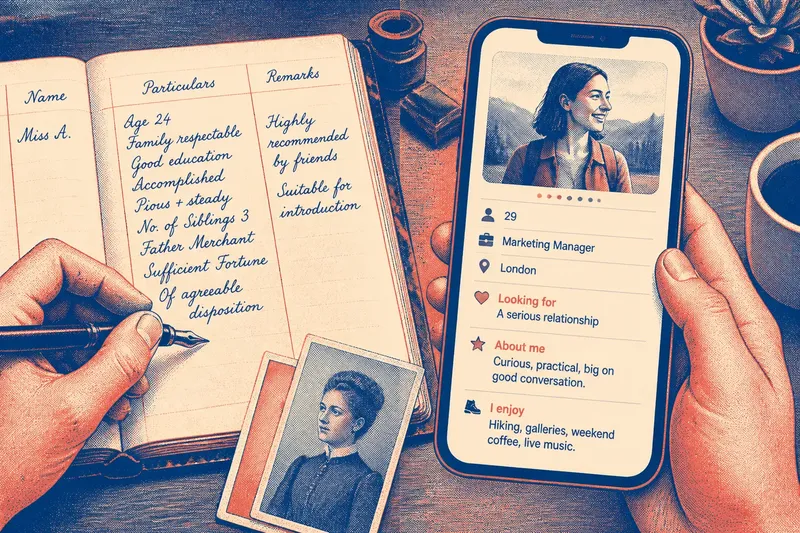
The common mistake with match descriptions is treating a compact account as a complete portrait. The cost is simple: you may mistake the writer’s choices for the person’s character. From matchmaker’s ledger to profile card, descriptions have always depended on who was writing, who would read them, and what the format allowed.
The ledger’s audience
In some communities and periods, written descriptions helped relatives or intermediaries consider an introduction before the prospective partners met. Their use was not uniform, and surviving records reflect particular places, families, and customs rather than a single history of courtship.
Where such descriptions were used, their audience shaped their contents. Family circumstances, occupation, education, community ties, religious observance, and reputation might matter because they helped readers judge whether an introduction seemed suitable. A description could also characterize conduct or temperament, but those impressions came through the person writing them.
A ledger was not necessarily a neutral record. The matchmaker might have limited space or incomplete knowledge, and could have an interest in presenting an introduction favorably. The person described might have had little say in the wording. A polished account could turn a preference into a credential or omit a fact considered inconvenient.
Read a historical description as evidence of what its writer and intended audience valued, not as an unedited disclosure by the prospective partners.
Details with a purpose
Written introductions could gather information that made sense in their particular social setting. A family’s standing, a person’s work, and a household’s plans might help answer a practical question: would an introduction be worth arranging? Their relevance depended on the expectations surrounding that match.
Descriptions could also rely on shorthand. “Steady” might imply reliability to the writer while leaving the reader to guess what conduct earned the word. “Good family” might signal social approval without explaining whose approval counted. These phrases sound informative, but their meaning depends on local conventions and the writer’s judgment.
Omissions matter too. A record might say little about handling disagreement, an ordinary day, or whether the person wanted the life being proposed. The writer may not have known, or the document may not have been intended to address those questions.
When an old description sounds precise, check whether it names an observable fact or offers a social verdict.
From intermediary to self
In some settings, people came to have more opportunity to write or approve descriptions of themselves. The timing and extent of that change varied; it was not a single, universal shift from matchmaker control to personal authorship. The important distinction is who had a hand in choosing the words.
A self-written profile gives its subject more control over selection and tone, even when the available format is brief. That control is not unlimited. A form may ask about occupation, location, family plans, or free time. The person can answer, skip, or frame those prompts, but the form has already chosen which subjects belong on the page.
A profile is both self-presentation and a response to a menu designed by someone else. A reader may encounter it without a relative or matchmaker supplying context, so a few legible details can carry more weight than the writer intended. A line about weekend hiking, for example, names an activity; it does not by itself establish a person’s character.
Control over the wording does not turn a short profile into a full account of someone’s values or conduct.
The profile card
A contemporary card compresses identity into fields, prompts, and images. Its structure makes some details easy to compare, such as stated intentions or location. That convenience can help a reader notice relevant differences, but it can also make unlike details look equally informative. A hobby and a clear relationship intention are both entries on a screen, though they answer different questions.
Images add another layer of selection. They show appearance and chosen settings, not the circumstances behind them. A photograph at a crowded table cannot establish that someone prefers constant company. A portrait can be sincere without representing every mood or setting.
A short prompt encourages a memorable line. It may be playful, guarded, or plain. Brevity alone does not tell you whether a person is evasive or simply unwilling to write a miniature autobiography for strangers. Nor does a polished answer prove that the stated quality will appear in a relationship.
A profile card is a doorway to a conversation, not a small contract whose clauses have already been interpreted.
What can a profile tell you?
Why do profiles leave details out?
Space, privacy, platform prompts, and personal judgment all shape what appears. An omission may reflect a boundary, a skipped field, or a subject the person has not thought to mention; it does not explain itself.
Can a profile show compatibility?
It can show stated preferences and practical circumstances that may matter to a reader. It cannot establish how two people will communicate, respond to tension, or revise expectations together.
How should I read a broad description?
Translate the label into a question about observable behavior. If someone says “easygoing,” ask what that means in situations that matter to you instead of treating the word as a settled fact.
What should I do with an unclear answer?
Decide whether the missing detail matters enough to ask about, and do so without assuming the answer in advance. If it does not affect your decision, let the uncertainty remain ordinary rather than turning it into a mystery.
Reading the omissions
Separate what the format states from what you supply. “Wants a serious relationship” states an intention, but does not define pace, preferred routines, or the meaning of commitment. “Enjoys travel” names an interest, not a promise to share every trip.
Say you are considering an invented profile that lists family closeness as important but says little about daily life. You ask, “What does staying close to family usually look like for you?” The person says they call regularly and spend some weekends together. You then compare that stated routine with your own preference for more independent weekends. The result is a clearer question to discuss: whether both routines can fit, not a verdict based on the original phrase alone.
The same caution applies to historical records. A ledger’s praise may point to a quality the writer wanted a family to notice while leaving the conduct behind that praise undescribed. The gap is not proof of deception. It is a reason to distinguish the writer’s claim from what the document actually shows.
Questions worth carrying
Before relying on a profile detail, check what kind of information it is and decide what to do next:
- Check whether the detail is an observable fact, a stated preference, or an impression. If it is concrete and relevant, use it as stated; if it is an impression, ask what behavior it refers to or leave it unconfirmed.
- Check who chose the wording: the person, a relative, a matchmaker, or a form. If the source is clear, weigh the detail in that context; if it is unclear and matters, ask who supplied it rather than assuming authorship.
- Check what the intended audience may have wanted to hear. If the wording appears tailored to that audience, treat it as a claim shaped for them; if there is no clear audience, avoid inventing one and assess only the words present.
- Check which important question the format leaves unanswered. If the answer could affect your decision, ask about it; if it would not change your choice, let the gap remain.
- Check whether a broad label has an observable meaning. If the person can describe a concrete example, compare that behavior with your needs; if the answer stays vague, keep the label uncertain rather than treating it as evidence.
- Check whether an image or hobby is being asked to prove something larger. If it only shows a selected moment or activity, read it narrowly; if you need to know a preference, ask about the preference directly.
These questions are not a screening ritual. They keep a short description in proportion. Take a stated boundary seriously without assuming every vague phrase hides a problem, and notice a promising detail without treating it as a prediction.
The editor remains visible
Moving from ledger to profile card changed how information could reach a reader, though the route varied by place and period. An intermediary might select or summarize details for a family audience; a profile writer and a platform shape what a reader sees on a screen.
That difference can matter. A self-written profile offers room for personal voice and more authority over disclosure. Yet its prompts, format, images, and brevity still narrow what can be said. From matchmaker’s ledger to profile card, the useful question is not which format tells the whole truth. It is what the format lets you learn, who shaped the account, and what still needs a conversation.
When you read a match description, note the detail, notice its source, and leave room for the question it cannot answer. Its best use is to start an inquiry, not end one.