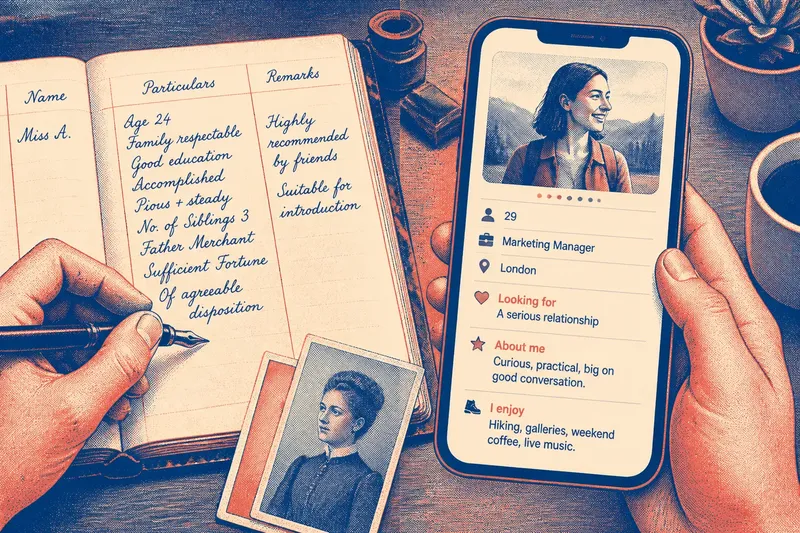
A First Conversation About What a Good Match Means to You
A first-date conversation about what a good match means can feel easier when you choose the moment well, share the floor, and know when to let it end.

The common mistake in a first-date conversation about what a good match means is bringing it up before the two of you have found a rhythm. Asked too soon, a personal question can sound like a screening prompt; asked at a calmer moment, it can become one part of an ordinary conversation.
Choose the moment
Wait until you have both settled into the date. A lull after ordering, or a natural turn toward dating and relationships, may give the subject room. Avoid raising it while one person is distracted, rushing, or trying to solve a practical problem.
You do not need to wait for a perfect opening. A simple transition works: “I’ve been thinking about what makes dating enjoyable for me. Is there one quality you appreciate in a partner?” Then share your own answer rather than leaving your date to perform alone.
If the topic feels abrupt, return to what you were discussing. The question can wait.
Set the pace
Offer one question and let the answer take its own shape. A short reply may mean the person has little to add, prefers privacy, or is still thinking. It is not an invitation to stack on follow-ups until a fuller answer appears.
Share a brief answer of your own. “I value directness because I prefer knowing where I stand” gives the other person something to respond to without demanding a matching disclosure. Keep the exchange balanced: take a turn, listen, and leave space for the conversation to move elsewhere.
One pause is not a crisis requiring a second prompt.
Read the room
Notice whether your date is engaging, asking you something in return, or shifting toward another subject. These are cues about the conversation’s current pace, not definitive judgments about the person. If their attention drifts or their answers become clipped, ease off rather than treating the moment as a puzzle to solve.
Say you ask what quality someone appreciates, and they answer briefly before asking about the restaurant. You can answer their question and let the topic go; the observable result is a smoother change of subject, not a forced explanation. If they return to the original topic later, you can pick it up then.
What should you ask, and when?
When is a good time to ask?
Choose a settled moment when both people seem available to talk, not the opening seconds or a rushed goodbye. If the conversation is already easy, a brief question is less likely to feel like an agenda.
How many follow-up questions should you ask?
Start with one and listen to the answer. Ask another only if the person seems willing to continue and you have a genuine point of curiosity.
What if the answer is brief?
Accept it without pressing for a more revealing version. You can share your own thought or move to another subject, giving the other person a clear way to keep the date comfortable.
How can you tell when to change topics?
Notice a direct change of subject, reduced engagement, or a question that opens a different thread. Follow that cue rather than returning to your prompt as if it were unfinished paperwork.
Keep the exchange reciprocal
A conversation becomes an interview when one person asks and the other keeps supplying answers. Take turns, respond to what you heard, and let a related subject emerge naturally. If your date mentions enjoying curiosity, you might ask what they have been interested in lately, then offer something you have been learning about yourself.
- Observe whether your date gives a short answer; if they do, then share briefly or change subjects instead of adding multiple prompts.
- Observe whether they ask you a question in return; if they do, then answer and continue the exchange, but if they do not, then avoid treating reciprocity as something to demand.
- Observe whether their attention stays with the topic; if it does, then offer one relevant follow-up, but if it drifts, then move to a more comfortable subject.
- Observe whether you are doing all the explaining; if you are, then pause and leave room for the other person, but if they seem ready to continue, then add a concise thought of your own.
- Observe whether either person signals discomfort; if they do, then acknowledge it and drop the question rather than asking for a reason.
- Observe whether the conversation naturally shifts to another subject; if it does, then follow it, but if both people return to the original topic, then continue without restarting the exchange from the beginning.
Reciprocity is easier to hear than to score.
Respect a boundary
A first date does not require anyone to explain personal history or provide a complete account of relationship needs. If your date seems uncomfortable, make the question optional: “No need to answer if you’d rather not. I was curious, but we can talk about something else.” Then actually change the subject.
You can keep your own answer broad, too. “I appreciate kindness in small interactions” is a complete response; you do not owe its backstory. Leave room for the other person to do the same.
When the timing feels wrong, return to the meal, the place, or a subject you were already enjoying. A prompt is not a scheduled agenda item.
Close the subject
When the exchange has run its course, acknowledge what you heard and move on. “I like how you put that” is enough; there is no need to turn a pleasant answer into a ruling about the date.
A first conversation about what a good match means can show how easily both people share the floor. Keep the pace comfortable, notice whether each person has room to speak, and let the subject end when the conversation asks to move on.